

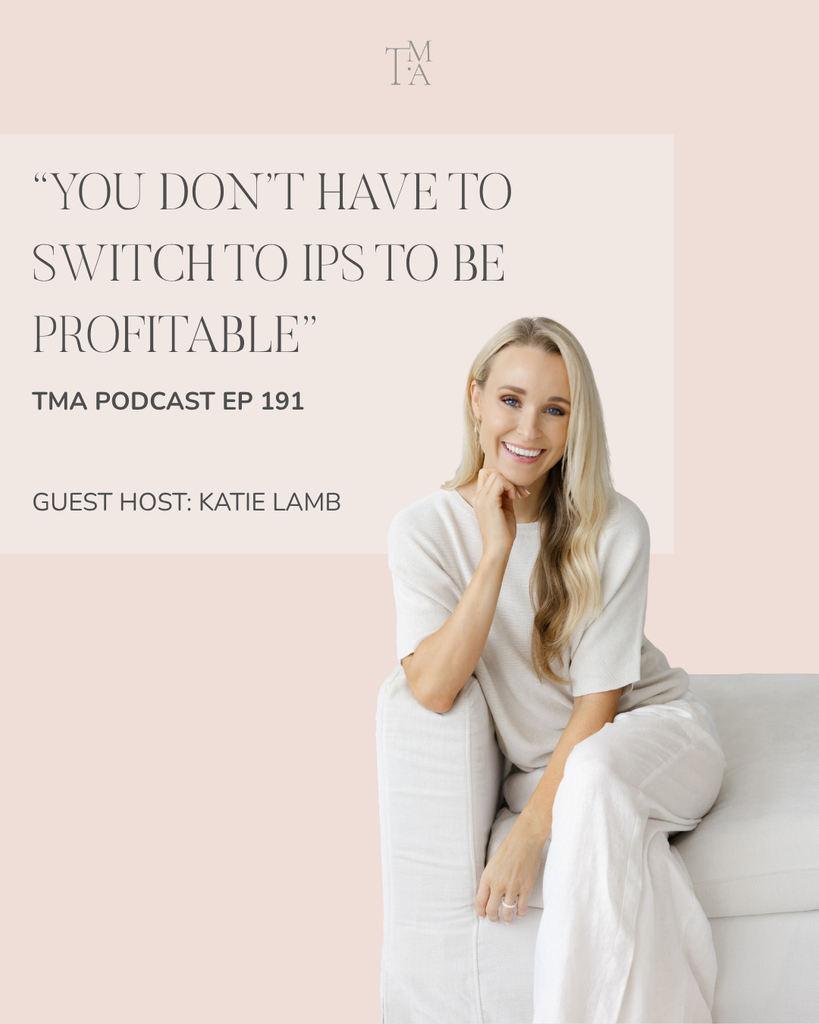
IPS (In-Person Sales) has been at the center of photography pricing conversations for the last few years, and if you’ve been on the outside of that discussion, wondering whether you missed a memo, this episode of the Motherhood Anthology podcast is for you. TMA’s Director of Education, Katie Lamb, walks through why the pricing model you use matters far less than whether the numbers behind it support the business you want to build.
Katie has watched members build beautiful, profitable businesses with IPS, with all-inclusive pricing, and with plenty of approaches in between. She has also watched photographers start to believe that the only way to grow is to abandon their business model entirely. Her perspective is far more encouraging: often the model is not the problem, the math is.

Why the Math Matters More Than IPS or All-Inclusive
Katie begins by clearing up a common misconception: pricing is not a two-camp debate. All-inclusive simply means one flat rate that covers all the digital files, and it says nothing about whether that rate is modest or premium. IPS is one method, all-inclusive is another, and hybrid models, collection-based pricing, and tiered packages that blend prints and digitals all sit alongside them. None is inherently more profitable, and none guarantees profitability just by being chosen. A photographer can underprice an IPS package the same way she can underprice an all-inclusive one. In Katie’s words, “the model isn’t the hero here and it isn’t the villain either. The math is.”
She also gives IPS its due. The in-person sales appointment creates a moment where you and your client sit with the images together, and that emotional context naturally raises what people are willing to invest. Seeing a print in your hands, or imagining it on your own wall, is something a gallery of digital thumbnails cannot recreate. There is also no built-in ceiling, so a session that might have topped out at a $1,500 package can grow into a much larger order depending on what the client falls in love with. The reminder is that revenue is not profit. Profit is what remains after the cost of delivering the service and the time it took you to earn the money.
To show how this plays out, Katie walks through a hypothetical.
Client A books an IPS photographer and spends $2,500 on a session fee, wall art, and an album. Behind that number are the session, the ordering and reveal appointment, product ordering and proofing, packaging and delivery coordination, and follow-up communication, which can easily add up to ten hours or more, along with real cost of goods sold.
Client B books an all-inclusive photographer and spends the same $2,500 on one flat rate for the session and all the digital files. The time behind that number is the session, the edit, gallery delivery, and communication that is often partly or fully automated, with little to no product cost. Same headline number, very different hourly rate. Neither photographer did anything wrong, and IPS remains a very strong choice for someone who loves the sales process and has the systems to make that time investment worthwhile. The point is that a revenue figure alone never tells the whole story.
Three Places Pricing Tends to Go Off Track
Katie sees the same patterns show up in every model. The first is that the cost of doing business never gets built into the number. Many photographers have not worked out their true hourly rate or how many hours they spend on each client, from shooting and editing to communication, gallery prep, and delivery. Without that information, you are guessing about profitability, and the fix is arithmetic rather than a mindset shift. Your pricing needs to cover your cost of doing business first, not arrive as an afterthought once the numbers already feel settled.
The second pattern is giving away too much of what makes your work valuable. This shows up often in all-inclusive pricing, where the digital files become the product and everything else (the experience, the editing, the artistry, the expertise) gets tossed in. Your clients are paying for your eye, your experience, the way you guide a session, and the finished work you deliver. Pricing based mainly on how many files someone receives can undervalue everything that happens before those files reach their inbox.
The third pattern is the one Katie believes most photographers overlook: how much time each client requires. Two photographers can charge the same amount and bring in the same revenue, yet one ends up far more profitable simply because she spends fewer hours with each client.
Katie shares that she shoots almost all of her sessions within a mile or two of home and uses automations for much of her client communication. That does not mean her clients receive less care. It means she has been intentional about where her time goes, so the hours she does spend with clients are the ones that matter most.
She calls reducing your time investment “a legitimate profitability lever, the same as raising your prices.” Two photographers can both book 15 sessions a month, and one can be thriving while the other is exhausted and quietly resentful of a business she used to love. The difference often comes down to whether the hours and costs behind each session were ever counted.
Choosing a Model That Fits Your Business and Your Life
Once you have done the math, you can ask a better question. Katie suggests starting with your cost of doing business, the number of sessions you can realistically and sustainably shoot each year, and the income you need your business to produce. If that work tells you each session needs to bring in $3,000, you can then ask whether you are comfortable charging that amount upfront and whether your brand is in demand enough in your market to support it.
If the answer is no, your business is not doomed, and you do not have to keep charging less and hope volume makes up the difference. It may simply mean all-inclusive is not the best structure for this stage of your business. That is where the space between the two camps becomes useful. IPS or another method might let you start with a smaller upfront investment while giving clients the chance to spend more once they have seen their images. A hybrid model could include a set number of images with the option to purchase more. Collections or tiered packages can make it easier for clients to choose an investment level that works for them.
Katie also encourages photographers to ask what they enjoy, because earning potential should not be the only factor. She could add more touch points to her own business and possibly increase what each client spends, but that is not how she wants to run it. As she says, “You don’t have to choose a pricing model simply because someone else is making a lot of money with it.”
Conversations like this one are a big part of why education and community matter so much in a photography business. Pricing decisions feel much lighter when you have mentors who can help you work through the numbers and a community of photographers who understand the questions you are asking. Inside TMA, that support is here to help you build a business that is profitable, sustainable, and shaped around the life you want, whether your model ends up being IPS, all-inclusive, or something in between.
Listen and Learn More
If you have been wondering whether you need to change your pricing model or simply understand IPS vs all-inclusive better, this episode is for you. Katie’s reminder is that the goal is to build a business that works for you, your clients, and your market, with numbers that support it.
Find Katie at katielamb.com or on Instagram at @katiebethlamb.
Ready to build a business that reflects your own creative voice? The Motherhood Anthology membership gives you access to expert mentors, live coaching, monthly marketing suites, and a private community of photographers who are invested in your success. Learn more and join at themotherhoodanthology.com.

The Motherhood Anthology is a community and educational resource for photographers who want a profitable and sustainable business they love. With 15+ expert mentors and 7+ years of proven content, TMA helps portrait photographers build confident, thriving businesses through monthly education, mentorship, and a supportive community of 700+ members.